
The Rising Power Demands of AI Data Centers
Training today’s largest AI models often requires tens of thousands of AI accelerators (xPUs) working in unison, creating massive and unpredictable demands on power systems. Traditional Data Centers average 5–10 kW per rack, whereas one for AI can demand 10x more.

Renewable energy, a containerized BESS’, and a Data Center are highlighted.
Learn about how other electrified applications can benefit from DKCMS®. Image copyright Dukosi.
Power Variability and Grid Stability Challenges
It’s not only the level of power demanded that poses challenges to power supply reliability, the AI workloads themselves also add a layer of complication. A paper1 co-authored by Microsoft, OpenAI, and NVIDIA describes how large AI workloads experience high variability in power consumption during the initial “training” phase2 as a new model is built; power usage swings dramatically as compute-intensive phases draw enormous energy, while communication-heavy phases require much less.
In 2025, Google Cloud representatives evidenced a ~15x difference in load fluctuations between a traditional Cloud and AI Data Center, from 1.5 MW to 15MW peak-to-trough swings in just seconds3. These fluctuations don’t just challenge Data Center infrastructure; they can also ripple outward to affect the power generators or broader power grid. As a result, stabilizing these workloads has become a critical priority for operational reliability.
Where do Battery Energy Storage Systems (BESS) fit in Data Centers?
Despite these considerable power supply challenges, AI data centers still require “five nines” uptime (99.999%), meaning outages must be almost entirely avoided. Battery Energy Storage Systems (BESS) are therefore an essential component of AI data center infrastructure. Recent trends show that energy storage solutions are converging around two categories: systems deployed outside the facility and systems deployed inside it.
Outside the facility, standard BESS shipping containers are now typically designed for 2- to 4-hour durations, with the industry increasingly moving toward larger 8-hour systems. These installations provide substantial backup power, support grid stability, and reduce electricity costs during periods of peak pricing.
Inside the facility, energy storage systems are far more varied. These UPS-style energy storage products must be tailored to the specific requirements of the compute infrastructure, and their designs are driven by the need to respond to massive load fluctuations within milliseconds. Another reason these systems resist standardization is that data center space must be used as efficiently as possible. Any space not dedicated to compute resources represents a cost that must justify its presence.
The challenges are significant.
A battery architecture must be both scalable and flexible. Energy storage must integrate closely with the physical layout of the racks. The benefit is straightforward: shorter distances mean less copper, lower losses, and greater use of shared cooling infrastructure.
With a single compute rack potentially worth millions of dollars, the tolerance for fire risk is effectively zero. Battery Management Systems (BMSs) must be capable of shutting down a module before a safety event occurs rather than simply responding to one. To achieve this, they must detect thermal anomalies as quickly as possible. In practice, this is only achievable when the temperature of every cell is continuously monitored.
At the same time, current requirements are enormous. As a result, the industry is moving toward extremely high-voltage systems, often operating at up to 1500 V. These higher voltages reduce current losses, decrease copper usage, and minimize heating effects.
These requirements are exceptionally demanding. Battery architectures must minimize the risk of electrical isolation issues while delivering the highest levels of safety and reliability.
If that were not enough, they must also support rapid design cycles and fast validation processes to meet aggressive deployment schedules.
Overcoming these challenges is achievable.
As new data center designs continue to adopt the latest AI silicon and compute platforms, power infrastructure must now be viewed as a fundamental design consideration. This includes embracing advanced battery architectures and technologies to unlock the full potential of next-generation systems.
Dukosi Cell Monitoring System (DKCMS®) Advantages

The smart cell architecture of the Dukosi Cell Monitoring System (DKCMS) enables industry-leading cell voltage accuracy and cell-level temperature monitoring. Both capabilities contribute to more accurate estimations of State of Charge (SoC), State of Available Power (SoP), and State of Health (SoH).
Accurate SoP estimation is critical for frequency stabilization, peak shaving, and rapid power delivery. Meanwhile, accurate and granular SoH data enables maintenance requirements to be identified further in advance, helping operators maintain system uptime and avoid unexpected interruptions.
Cost Optimization and Grid Resilience
Beyond operational stability and capacity, operating costs are also a key consideration. BESS installations can charge when electricity prices are low and discharge when prices are high, helping offset both predictable and unexpected fluctuations in energy costs.
Improved SoC and SoP accuracy allows operators to extract more usable energy from each cell. As a result, fewer cells may be required for a given system size, or additional capacity can be unlocked from existing assets. Both outcomes reduce costs.
In addition, these capabilities can provide a critical advantage during rare periods of grid instability. The ability to accurately monitor cells and confidently operate them for a short period beyond standard guidelines can be highly valuable when maintaining operational continuity is the priority.
Simplicity, Flexibility & Scalability Advantages
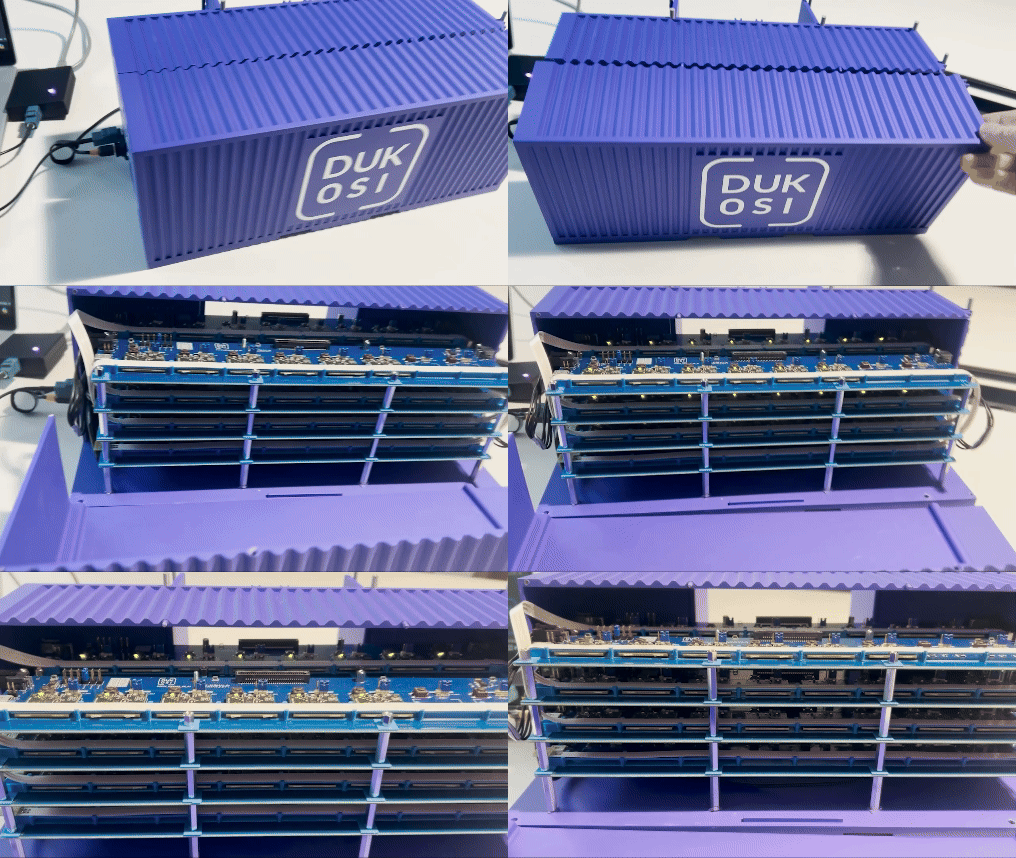
DKCMS is a revolutionary battery architecture that offers exceptional reliability and safety through simplicity.
Each Cell Monitor uses Dukosi’s proprietary C-SynQ® communication protocol to synchronously transmit data to a Dukosi DK8202 System Hub via near field RF over a single bus antenna.
This innovation can be up to 2x as reliable while using 10x fewer components than a conventional wired BMS architecture. By eliminating the complex wiring harness and reducing the number of vibration-sensitive connections, DKCMS significantly improves system robustness.
With inherent electrical isolation and security through the near field network, Dukosi’s contactless solution delivers wired-like performance while maintaining the advantages of a star-network architecture.
The System Hub can address up to 216 cells individually. While it also supports traditional modular battery designs, eliminating the need for them enables scalability at the cell level, allowing battery designers to add or remove individual cells rather than entire groups of cells. This flexibility makes it easier to optimize designs for either power requirements or physical space limitations.
If requirements change, such as cell capacity, chemistry, or total cell count, DKCMS can be scaled without requiring extensive redesign or recertification. This simplifies and accelerates both development and manufacturing while maintaining protection against unauthorized devices within deployed systems.
Integrated Cooling for Racks & Batteries
The opportunity for deeper integration between compute racks and battery systems expands further when both can share liquid cooling infrastructure. Shared cooling systems can reduce space requirements, material usage, and overall costs.
Both industries are also exploring immersion cooling for next-generation designs, creating opportunities for additional synergies that can reduce costs even as power densities and cooling demands continue to increase.
Safety remains a key consideration in these integrated environments. However, advanced battery monitoring technologies such as DKCMS help mitigate these concerns. DKCMS uniquely monitors up to three temperature points on every cell and immediately alerts operators when any individual cell exhibits abnormal thermal behavior. As a result, the risks associated with tightly integrated battery and compute environments are becoming increasingly manageable.

An example of DKCMS operating submerged in an inert dielectric fluid
Cybersecurity and Provenance in Battery Systems
The U.S. Cybersecurity Committee also raised concerns during its August 2025 meeting, where industry leaders highlighted risks from non-standard or under-documented batteries sourced from unapproved suppliers in grid expansion projects. These concerns apply not only to digital equipment but also to the battery cells themselves, making supply chain verification critical in infrastructure projects.
By integrating on-cell storage of cell-level data for provenance information, DKCMS can enhance supply chain security. The Dukosi Cell Monitoring chip can even be embedded inside the prismatic cell can during manufacturing, making it physically tamper-proof. When operational, DKCMS uses near field contactless connectivity and C-SynQ® closed communications protocol that’s fully contained within the battery, unlike legacy far field wireless BMS’.
Conclusion: A Balanced Solution for the AI Power Era
Operational performance, reliability, safety, deployment speed, supply-chain trust, cybersecurity, and cost are usually a difficult balancing act, but the Dukosi Cell Monitoring System can tick all the boxes for even the most demanding BESS operations.
- Power Stabilization for AI Training Datacenters, 21st August 2025 ↩︎
- https://www.sciencedirect.com/topics/computer-science/training-phase ↩︎
- https://semianalysis.com/2025/06/25/ai-training-load-fluctuations-at-gigawatt-scale-risk-of-power-grid-blackout/ ↩︎
All original content, graphics, images and media are copyright of Dukosi.
About the author

Joseph Notaro
President